Accounting and quotas
A wrong answer here is a wrong invoice, not a stack trace — which is why this
logic has the strictest tests in the repository and why its conventions are
written out at length. Every request that passes through a /v1 route goes
through the same pipeline in routers/_metered.py:
resolve → reserve → record → settle
- resolve — authenticate the caller (API key or OIDC bearer), load user,
billing group and model (a handful of SELECTs; the whole metered request is
pinned at 5 SELECTs and 2 writes by
test_query_counts.py). - reserve — ask the quota engine whether this request may proceed before the upstream call, and tentatively debit its estimate.
- record — write the in-progress ledger row before the upstream call, so a crash mid-request is visible.
- settle — when the response (or its terminal SSE frame) arrives, count the tokens, compute the cost, and finalize the row.
That ordering is the whole design. Each piece exists because the naive version fails in a specific, boring, expensive way.
The ledger
Every admitted request writes one row to usage_records — before the upstream
call, not after. A request the quota refuses (a 429 with code:
quota_exceeded) writes none: it never reached a provider and cost nothing. The row carries the caller, the billing group (see
Billing groups for what decides it), the requested and served
models (which can differ behind a router),
token counts, status, redaction provenance (redaction_scope,
redaction_rule_id) and three cost figures.
The statuses are in_progress (written before the upstream call; a row that
stays there was never settled), completed, client_disconnected (the caller
hung up before the terminal frame — tokens are counted locally and stamped
estimated), upstream_error, and blocked (refused by redaction policy —
zero tokens, zero cost, but counted, because "this deployment refused 400
prompts last month" is a number a data-protection review asks for).
Requested by way of an alias. model_id and model_name are always the
model that served the request, even when the caller sent a model alias;
requested_model keeps the name they sent, and is null for an ordinary request.
Billing follows the target — prices, quotas and reports read the served model —
and the alias is kept beside it so a report can say "via alias" and a retarget
cannot rewrite the row. It is a copy of a string, not a foreign key, so an
alias that is deleted or retargeted leaves the ledger readable.
Fallback attempts. An alias with several targets can try more than one for a
request. Each attempt is its own row under the same request_id, numbered in
route_attempt: a failed attempt is upstream_error at zero cost against the
target that failed, and the attempt that served is billed to the target that
served it. A requests limit counts every attempt. See
routing policies.
On a member's own key. A request served by a member's own provider and
key writes a row too, with byok = true, the member's user_id, no
billing group and the model name my/<name>, priced at the member's own price
rows (an unpriced model has no cost). It is for their information only: it
reserves nothing and counts in no quota (including the rebuilds from the
ledger), and no group, billing or administrator report adds it up. It shows in
the member's own usage as a separate total.
The request log
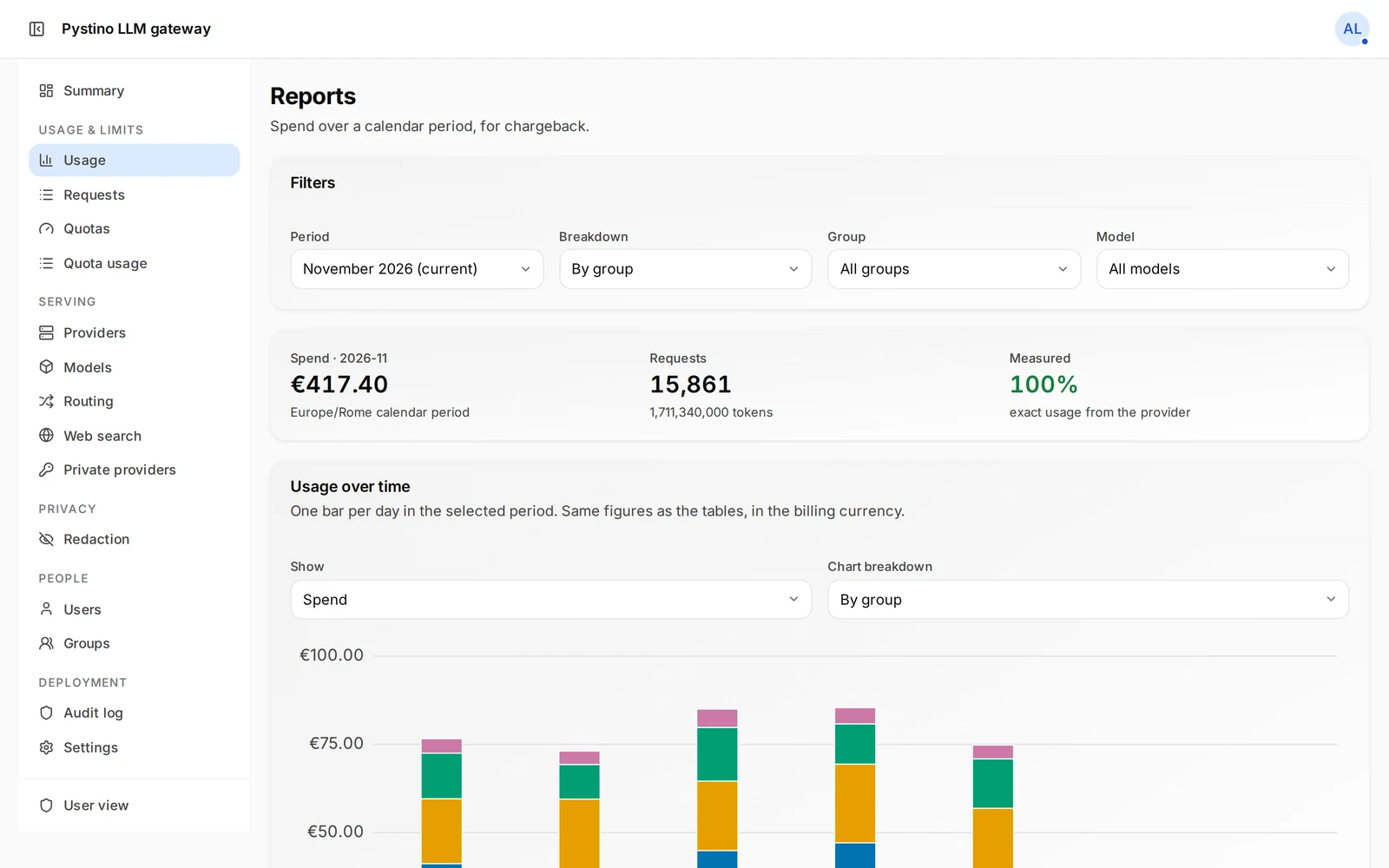
Reports by provider, and the console's charts. GET /api/admin/reports/usage
(and /api/me/reports/usage for the caller's own) takes group_by=provider:
the provider that served the request, read from the model that served it, so a
request sent to an alias and routed to a model on another provider counts for
that provider. Rows whose model has since been deleted appear as
"(unknown provider)". Adding split_by (group, user, model or provider;
not user on the personal route) to a group_by=day report returns one row per
day and breakdown value; the console's usage charts draw from exactly this, in
the billing currency, with the largest six series plotted and the rest as
"Other".
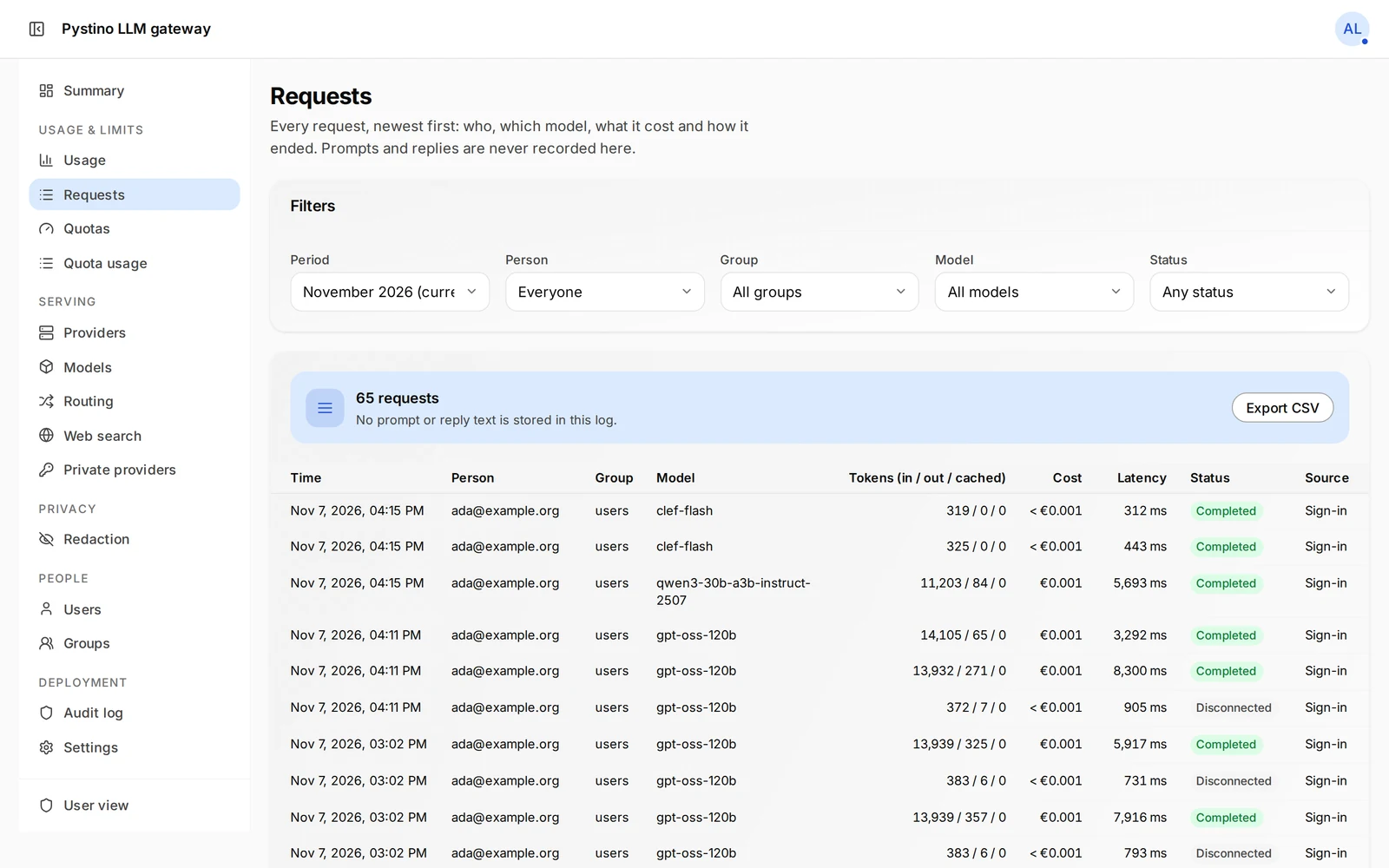
The reports add rows up; the request log lists them. It shows one line per
request, newest first: time, person, billing group, the model asked for and the
model that served it (the alias and its target when an alias was used), tokens in,
out and cached, cost, latency, status and source (api_key when a gateway API
key authenticated the request, token for a sign-in token or session). A request
that fell back to another target of an alias has one line per attempt, with the
attempt number.
It never carries content. The listing reads named metadata columns only.
assistant_text and error_message are not selected, so neither the reply nor a
provider error that echoed the prompt can reach the API, the console or the CSV.
| Route | Who | Notes |
|---|---|---|
GET /api/admin/requests |
administrators | Every request. Filters: period or start and end (as for the reports, default the current month), user_id, group_id, model, status. |
GET /api/admin/requests.csv |
administrators | The same filtered set as CSV. |
GET /api/me/requests |
any signed-in person | Only the caller's own requests. Same filters except user_id, which is ignored: the user is fixed to the caller. |
GET /api/me/requests.csv |
any signed-in person | The caller's own, as CSV. |
Both listings use the standard pagination envelope (items, total, limit,
offset; 50 rows by default, 200 at most). model matches either the alias the
caller asked for or the model that served the request. status is one of
in_progress, blocked, completed, client_disconnected, upstream_error.
Unlike the reports, the log includes in_progress rows, so a request that never
settled is visible.
The CSV writes cost as a plain decimal string, never a float or scientific
notation, and prefixes a text cell that starts with =, +, - or @ with an
apostrophe so a spreadsheet does not run it as a formula. An export holds at most
100,000 rows; a larger set is refused with export_too_large rather than cut, so
narrow the period or add a filter. In the console, administrators find it under
Requests, and everyone has Your requests in the sidebar.
Running without a ledger
A deployment that wants routing, keys, model access control and redaction — and does not care what anything cost — can turn the ledger off:
Three things to know.
Off means no row, not a row of zeros. Nothing is written, because a row
saying a request cost nothing cannot be told apart from one where the
arithmetic failed — and keeping those distinguishable is what
usage_source, cost_source and own_prices_fallback exist for. finalise
returns before the price arithmetic as well, since every figure it computed
would be discarded.
The report says so. An empty usage report is otherwise indistinguishable
from an idle week, so _disclosures leads with a line stating that metering is
off, that the report covers nothing, and that requests are still served and
access still enforced.
Quotas without a ledger are refused at startup, and the error names the
other flag. Counters are a cache rebuilt from usage_records — which is why
flushing Valkey alone does not reset a limit — so with no ledger every counter
comes back at zero and every ceiling silently passes. A quota that refuses
nobody is worse than no quota, because somebody configured it and believes in
it. The asymmetry is deliberate: metering without quotas is fine, quotas
without metering is incoherent.
(Knowledge ingestion runs in the chat, metered through the embedding endpoint.) The consequence this section is here for: ingestion bills through the same path, so an unmetered deployment records no indexing spend either — and a large ingestion run can cost more than the chat traffic it serves.
Three cost figures, one meaning each
| Column | Meaning |
|---|---|
cost |
What we charge. Quotas and reports read this. |
computed_cost |
Always our arithmetic — tokens × our price table. |
upstream_cost |
Always the counterparty's figure, when one is reported. |
cost_source says which figure billed: our prices, or the counterparty's
reported cost (billing mode is a per-provider choice). Both figures are recorded in both
modes, so a divergence is always reconstructable.
own_prices_fallback is the value that must never appear silently: a
pass-through provider reported nothing, so the row was charged from our price
table instead. It is stamped, not hidden. A client that hangs up mid-stream
always lands here — the provider served the tokens but sent no usage, so the
tokens are counted locally and billed from our prices.
An unpriced model reserves nothing, so it has no cost ceiling at all.
unpriced_model_count on the provider listing is the warning; treat it as an
open invoice waiting to happen.
Two prompt conventions, and they are opposites
OpenAI's prompt_tokens includes cached tokens; Anthropic's
input_tokens excludes them. Each surface therefore has its own named
reader in accounting/cost.py. They must not be merged into one tolerant
parser: a tolerant parser silently double-counts (or under-counts) one of the
two vendors, and neither error is visible on a single request.
What is tolerated across names is spelling: there are four names for the
cache-write quantity (_CACHE_WRITE_KEYS), because vendors name the same
quantity differently. Reading only one would bill those tokens at the input
rate. The distinction from the rule above is the point — those differ in
meaning, these differ only in spelling.
Images: a price per image, and per extra megapixel
An image model is billed per_image for each picture, or its own rate for a size
in per_image_by_size; a model that also has per_extra_megapixel adds that
rate per megapixel above the first (per_image + max(0, MP - 1) x rate). The
megapixels come from the provider's usage.out_images_mpx when it reports one,
else from the size. See Images.
Audio: a price per minute
A transcription model is priced per minute of audio (per_minute on the
price row) and metered per second: the ledger's audio_seconds is the
billable quantity and the cost is seconds / 60 × per_minute. Like an image
row, an audio row shows real cost against zero tokens, and the usage reports
carry an audio_seconds figure (and a CSV column) beside images. The seconds
come from the provider's reported duration where it gives one, otherwise from
the file's header, otherwise from its size; audio_seconds_source on the row
says which, and a size-based figure is counted as an estimate. The reservation
before the call is the file's measured length, or a pessimistic bound from its
size when it cannot be measured. See
Speech to text.
Web search: a price per request
A search this gateway runs against a backend of its own (POST /v1/search, or
the passthrough POST /v1/search/{backend}) is billed per request, at a
price an administrator sets for that backend on the Web search screen. One
search is one request, whatever the number of results. The vendor's real
invoice is settled outside the gateway; this price is what Pystino charges and
reports.
Three states, kept apart on the row.
| State | cost |
search_price_id |
How you get there |
|---|---|---|---|
| unpriced | 0 | null | no price was ever set for the backend: where every backend starts |
| billed out of band | 0 | the price row | a price of 0: you settle the vendor's invoice yourself, and say so |
| priced | price × requests | the price row | any other price |
Unpriced is the gap, and reports name it ("N web search(es) had no price set", and a count beside the searches column), so the total reads as a floor. A price of 0 is a decision and is not reported as a gap. Upgrading therefore bills nothing you did not set a price for.
Prices are effective-dated and append-only, like model prices. Setting a
price adds a row that applies from its start time (now, or a later time to
schedule a change); nothing edits or deletes a row, so a change never rewrites
what an earlier search was billed. A price is per backend (exa, linkup, the
plugin name the ledger records as own_search_backend), with an optional
per-tier override for a backend whose tiers cost differently: a search that
reports a tier takes that tier's price when it has one, else the backend's.
Today the gateway runs every search at the vendor's default depth and records
no tier, so the backend price is the one that applies. Prices are read at the
moment the request starts.
What lands on the row. cost (in the billing currency), cost_native and
cost_currency (in the price's own currency, with cost_fx_rate when it
differs), computed_cost, and search_price_id naming the price row. A price
in another currency converts at the day's rate (ADR 0054); with no rate
available the search is recorded unpriced and an error is logged, never billed
at a guessed rate. A search is billed whether or not the vendor answered, for
the reason it is counted whether or not it did: the request was made.
Quotas count it like any other cost. A cost rule sees the search price in
the reservation and in the settled figure, and a request-count ceiling for
searches (own_search_requests) still bounds volume as before. The gateway
does not itself run searches inside a chat completion; a provider's own
server-side searches are a different thing (search_count, priced by the
model's per_search rate, ADR 0058).
Searches made before a price existed are not repriced. Their rows keep a cost of 0 and a null price reference, and reports continue to count them as unpriced.
Money is a string, end to end
- The column type is
Numeric(24,12)through aMoneyTypeDecorator; in Python and JSON, money is a string.Numericround-trips zero asDecimal("0E-12")— a float anywhere in the path turns that into0.0and the ledger starts lying in the twelfth decimal. - Never parse an amount into a float, including in the browser.
- Stored precision is twelve places and is real — it is kept. Displayed
precision is at most three, defaulting to milli-units:
formatMoneyinpackages/ui,format_money_proseingateway/types.py. The default is opt-out ({ exact: true }), because when it was opt-in four of the five screens leaked twelve decimals by saying nothing.€12.50is not written€12.500, and a real amount never renders as zero — it reads< €0.001, because€0.00for genuine spend makes the ledger look broken. - Admins reach full precision with the Exact figures toggle in the console
identity menu (a
MoneyPrecisionContext); a bareformatMoneycall made outside<Money>has to read it by hand. - All prices and quotas share one currency (
GATEWAY_BILLING_CURRENCY). A model priced in anything else is refused rather than converted: a silent exchange rate produces invoices that look right and are wrong.
Usage tags: a session's own cost
A client may label its /v1 requests (chat completions, responses, messages)
with an x-pystino-tag header: printable ASCII, at most 128 characters; an
invalid label is ignored, never an error. The gateway stores it on the usage row.
GET /v1/pystino/usage/tags?tag=a&tag=b (1 to 100 tags, optionally between
since and until) then returns, per tag that has usage, the number of
requests, prompt, completion and cached prompt tokens, the cost with its
currency, and the first and last time. It reads only the caller's own
requests (another user's tag of the same name returns nothing) and only
gateway usage: bring-your-own-key rows and requests still running are left out,
which is the figure a quota counts. Cerea's agent proxy tags every request with
the coding session so the chat can show a session's and a turn's cost.
Quotas
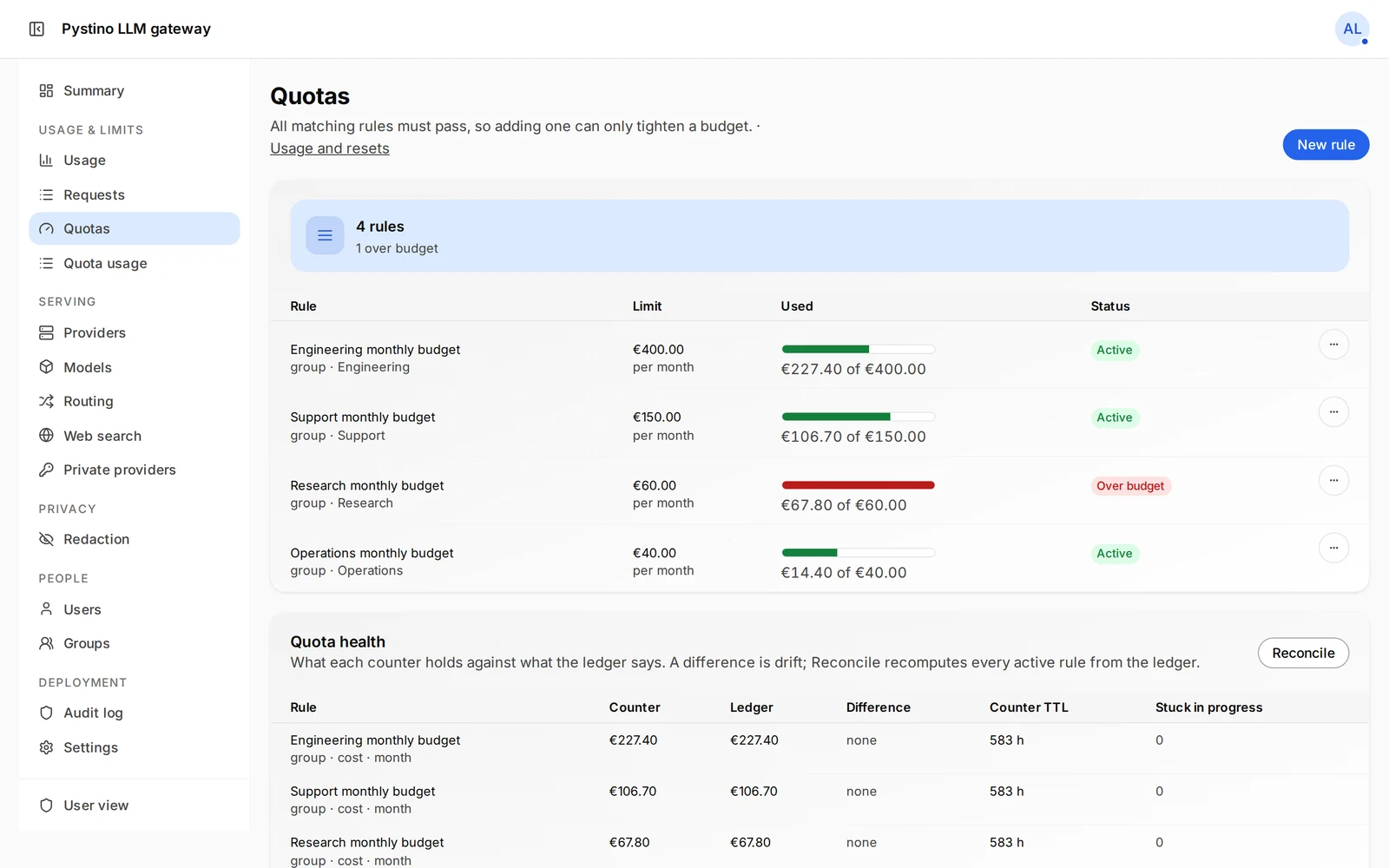
The quota engine is reserve-then-settle over stacked, multi-granularity rolling windows: global, group, user and API-key rules can all apply to one request, and all of them must pass — a permissive rule must not raise a ceiling someone else set.
- Why reserve: without a reservation, N concurrent requests each read the
same under-limit total and all proceed; the budget is exceeded by however
much N was. The reservation is a tentative debit that settles into the real
figure afterwards. Admission under concurrency is verified against real
Valkey by
scripts/test_quota_race_live.py, which drives 40 concurrent clients and gets exactly the arithmetic number admitted. - Overrun policy: the request that crosses the limit is admitted (it
reserved before anyone knew); the next one gets a 429. There is no
mid-stream cutoff via
max_tokensclamping — that is a deliberate choice, not a gap. - A spent quota and a rate limit are different 429s. A request the quota
refuses answers
429withtype: insufficient_quota,code: quota_exceededand aretry-afterheader holding the seconds until the window resets; a plain rate limit answers429withtype: rate_limit_error,code: rate_limited. A client that must tell them apart (waiting helps for one, and for the other only the reset or a larger quota does) reads thecode. The Cerea chat does, and says the quota is used up instead of asking the user to wait. - Billing periods are calendar-based (monthly, etc.) and are not rolling windows; a rolling window and a billing period answer different questions and the model keeps them apart.
- Valkey holds the counters; it is never authoritative. With Valkey gone,
quotas fall back to the database and evaluate correctly, just more slowly.
The counters rebuild from the ledger — which is also why flushing Valkey
alone does not reset spent quota: clear both
usage_recordsand the counters, or let the gateway restart and rebuild. - An admin reset (
POST /api/admin/limits/{id}/reset) zeroes a quota's consumption; a reason is optional and recorded in the audit log when given. Billing history is never touched. - A rule that is enforced per user (a group rule applied to each member, or
a global rule applied to each user) can also be reset for one user: the
same endpoint with
"user_id": "<id>". That user's count for that rule goes back to zero and nobody else's moves. A shared rule (a group's total, a global total) has no per-user count, so naming a user on it is refused (422); a user who is not subject to the rule (not a member of its group) is a404.GET /api/admin/limits/{id}/resetslists both kinds, the per-user ones with the user's email. A per-user reset is stored as aquota_resetsrow carryinguser_id, audited aslimit.reset, and is deleted with the user on erasure (it would otherwise read as a reset of everyone) and moved to the surviving account on a merge. - Quota usage (
GET /api/admin/quota-usage, and/{user_id}) shows, per user, every active rule that applies to them: their ownscope=userrules, the global each-user rules, their groups' per-member rules, and the shared group or global totals they count towards (marked shared, with the shared figure). Each carries the figure for that user, read through the engine so resets apply, the window, when it next resets (a calendar period's end; for a rolling window, the estimated moment its oldest counted use leaves it) and the latest reset with who made it. An each-user rule that a user's override replaces is listed as replaced, not as a second budget. Non-administrators get403. The console's Quota usage is the one place quotas are reset: a per-user rule withuser_id, a user's own rule and a shared total whole (the dialog names everyone a shared reset counts), and a replaced rule offers no reset, matching the API's422.
Group rules: the total, or each member
A group rule caps who its budget belongs to, chosen when the rule is
created (applies_to; immutable like the scope and window, because either
change would abandon the consumption already counted):
aggregate(the default, and every rule that predates the choice): one budget for the group's total. Every request billed to the group counts, by all members together — including an API key's spend, which counts for the key's owner as a member.each_member: one budget per member of the group. A request billed to group G by user U counts against U's own share and nothing else: U's usage billed to other groups does not count, and other members' usage does not count. Spend through an API key counts against the key's owner. A member is a holder of a membership in the group; a request that has no user at all (no path reserves one today) would skip per-member rules, because there is nobody to attribute the spend to.
Where both kinds exist on one group, both are enforced — a request must pass every rule that matches it, as everywhere. Neither kind raises the other: a per-member rule does not lift the group ceiling, and the group ceiling does not absorb a member's overrun.
A worked example, on one group with a €500 aggregate rule and a €50 per-member rule, both monthly:
| Situation | Aggregate (€500/month) | Per member (€50/month) |
|---|---|---|
| Ada has spent €30 this month, Bill €20 | group total €50 — fine | each share fine |
| Ada reaches €50 | still fine (group at €50) | Ada refused, Bill unaffected |
| The group together reaches €500 | everyone refused | irrelevant once the aggregate refuses first |
| Ada bills €40 of her spend to a different group | does not count here | does not count against her share here |
A member can see their own share on the usage page (/v1/pystino/usage,
/api/me/limits): a per-member rule appears as their limit with their
own consumption, marked "applies_to": "each_member". It never shows
another member's spend, and a 429 for a per-member rule says the member's
share ran out — a 429 for an aggregate rule says the group's total did.
Operationally, a per-member rule is one counter key per member: the health view and Reconcile expand to one row per member (each member's budget is enforced independently, so drift is per member too), and seeding a new rule primes the members who already spent in the window. The rules list carries no single consumption figure for a per-member rule — the per-member figures live in the health table.
Everyone's own ceiling: a global rule per user
A global rule has the same choice (applies_to, immutable, and only
offered at global scope):
aggregate(the default): one budget for everything the gateway serves, all users together.each_user: one budget per person, counted over everything that person spends: through every group they bill to, personal usage, and API keys they own (a key's spend is its owner's). Nobody needs a rule of their own and nobody needs configuring: a user created tomorrow is capped from their first request. "Each person may spend at most €20 per month" is one rule.
A per-user rule counts under the person's ordinary user counter,
user:<id>, the same one an explicit scope=user rule for that person reads.
The two mean the same quantity (that person's total spend), so for the same
metric, window and reset they are one counter: one reserve, one settle and one
refund per request however many such rules apply, and seeding or reconciling
either repairs both. Counters stay apart where it matters, because a quota
reset is part of the counter key: resetting the global rule restarts every
person's count for it without touching an explicit user rule's counter, and
the other way round. The same holds for a reset for one user: it moves only
that person's counter for the each-user rule to a new key, so for them the rule
counts from zero while their own scope=user rule keeps its count, even though
the two normally share one counter.
Interactions, all of them the ordinary all rules must pass:
- With a group aggregate or per-member rule: independent; any of them can refuse. A person can be inside their group share and over their personal ceiling (they also spend through another group), or the reverse.
- With a global aggregate rule: also independent. The aggregate caps everyone together, the per-user rule caps each person; whichever is reached first refuses.
- With an explicit
scope=userrule for one person: both apply and the lower ceiling binds. An ordinaryscope=userrule cannot raise that person above the global per-user ceiling. To give one person a different figure, higher or lower, mark their rule as an override; see below. - A request with no user (no path reserves one today) skips per-user rules, as it skips per-member ones.
A refusal reads global per user limit of 20 cost per month exceeded (current
20): the figure is the person's own total, never anyone else's. A person sees
the rule in /api/me/limits and /v1/pystino/usage as their own limit with
their own consumption ("scope": "global", "applies_to": "each_user"), and
quota notifications (ADR 0052) for it go to the person whose budget it is: one
user's crossing never mails another user who asked to hear about the same rule.
Operationally the rule is one counter per user, and the cost of that is paid
in the maintenance paths, not on the request path (its query budget is
unchanged, which test_query_counts.py pins). Seeding a new rule, the cold
rebuild, Reconcile and the health view reach every user, and each does it
with one grouped ledger query per rule rather than one per person (seeding and
the cold rebuild first ask which users spent in the window). Health and
Reconcile list a row per user, including users with no usage, because drift
can be a counter that should be zero. The admin rules list carries no single
consumption figure for a per-user rule.
Overriding the per-user ceiling for one person
A scope=user rule can be created with overrides_each_user: true (the
console's "Overrides everyone's ceiling" checkbox, offered only for a rule on one
person). For that person it replaces every global each_user rule with the
same metric and the same window (same rolling length, or same calendar
period): they are held to the override's limit, which may be higher or lower
than the global one, instead of the global one. "Everyone has €20 per month,
Ada has €100" is two rules: the global each_user rule and Ada's override.
What an override does not touch: it replaces only the matching global per-user
rules, so a per-user rule for another metric or window still applies to that
person; and everything else still applies and can refuse them: the group
aggregate and per-member rules, the global aggregate rule, API-key rules, and
any other ordinary scope=user rule for them (a tighter one still binds, and
may sit beside the override for the same metric and window: the override flag is
part of a rule's identity). An inactive override replaces nothing. The flag is
fixed at creation, like applies_to, and is only valid on scope=user: the
API answers 400 elsewhere and a database check constraint refuses it
regardless of writer.
It is applied when the rules are loaded, so the request path costs no extra
query (test_query_counts.py). The override reads the person's user:<id>
counter for that metric and window, the same one the global rule reads, so
creating, deactivating or deleting an override moves no counter and loses no
count: the person's total is simply judged against another figure from the next
request. Seeding, the cold rebuild and Reconcile are unchanged. In the
health view the person's row for the replaced global rule is omitted (it is
not enforced on them); the override's own row, with the same counter and
ledger, is there instead.
A person sees the override in place of the global rule in /api/me/limits and
/v1/pystino/usage ("scope": "user", "overrides_each_user": true, their
real ceiling and consumption), so the chat's usage page needs no change.
Notifications (ADR 0052) follow the rules that are evaluated: the override
notifies like any user rule, and the replaced global rule does not notify that
person.
Rebuilds replace; they never add
Every path that fills a counter from the ledger (the start-up rebuild, seeding a new or re-activated rule, and reconcile) sets the counter to the ledger's figure. A calendar counter is overwritten with the period's own TTL; a rolling window has the buckets it reads deleted and the total written into the newest one. Because it is an overwrite, running it twice, or on a counter that is already right, changes nothing. (An earlier version added the ledger onto the counter, so a restart counted everything since the rule was created twice.)
Cold is read from the counters, not from a marker. At start-up each active
rule's current window is read; a window whose counter reads zero is rebuilt from
the ledger and a window with a value is left alone. One worker is elected with a
60-second q:rebuild-lock so N workers starting together run one ledger query,
but nothing depends on the election. There is no permanent "seeded" marker any
more: it was a second fact to keep true alongside the counters and it was not.
An idle deployment costs one query per rule and writes nothing.
What a replace can lose. The ledger is read, then the counter written; they are not one transaction and nothing is locked, so admission keeps working. An increment landing between the two, and a reservation in flight at that instant (counted by the counter, absent from the ledger until it settles), are overwritten. The window is one ledger query long, the loss is bounded by the traffic in flight over it, and it errs low, never high, so it cannot refuse a request that should have been admitted. The next reconcile or the window rolling over repairs it.
Quota health and reconcile
GET /api/admin/quota/health (admin only, read-only) lists every rule's
current window: the counter value, the ledger total, the difference
(counter − ledger; positive means over-counted, which refuses early), the TTL of
the counter key, the number of rows still in_progress after 30 minutes
(excluded from the ledger total, and the first suspect for a difference), and
whether the rebuild lock is held. A counter the store cannot read is reported as
null, never as zero. The same figures are the Quota health panel on the
Quotas page of the console. Without a browser session, docker compose exec
gateway pystino quota health prints the same figures as JSON; it is what
the deploy kit's tools/diagnose attaches to a report.
POST /api/admin/quota/reconcile (the panel's Reconcile button) recomputes
every active rule's current window from the ledger with the replace semantics
above and returns each window's before and after. It is recorded in the audit
trail as quota.reconcile with the counts of windows and of windows corrected,
and no figures. It is not run on a timer: drift should be rare now, and a
periodic overwrite would trade a rare, visible, repairable difference for a
steady small loss of in-flight traffic. Run it when the health panel shows a
difference.
Reconciliation
The reports can compare our ledger against a provider's own dashboard, row by
row. A row reconciles only when both sides have a reported figure
(upstream_cost IS NOT NULL on both) — which correctly excludes
client_disconnected rows, since the counterparty reported nothing for them.
One known imperfection, recorded rather than hidden: the reconciliation summary counts only the reconciled rows (a total covering 39 requests can sit next to a drift row about 34).
The estimated-usage disclosure names its cause. A request whose provider did
not report usage, and one whose client disconnected before the provider's final
usage report, are counted and explained separately
(estimated_disconnected_requests on each report row is the second kind), so
the report never blames the provider for a client that hung up.